☰
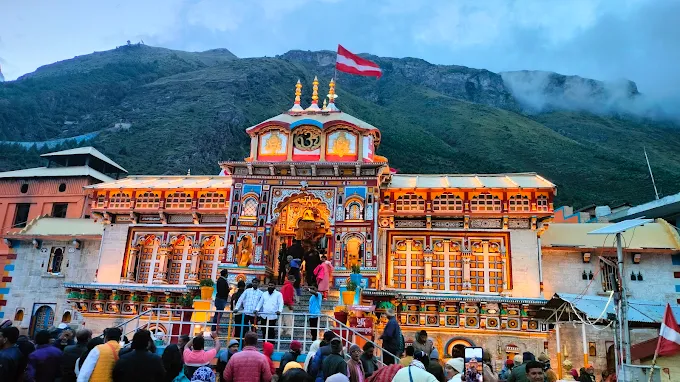
🛕 Lord Vishnu | 📍 Badrinath, Chamoli, Uttarakhand
Badrinath Temple, dedicated to Lord Vishnu worshipped as Badrinarayan, is among the holiest Hindu shrines in India. It is uniquely revered both as one of the four principal all-India Char Dhams established by Adi Shankaracharya (alongside Rameswaram, Puri, and Dwarka) and as part of Uttarakhand's Chhota Char Dham pilgrimage circuit. Furthermore, it is celebrated as one of the 108 Divya Desams, the sacred Vaishnavite abodes venerated in the Tamil canon by the Alvars. Situated in the Garhwal Himalayas at an altitude of approximately 3,133 metres above sea level along the right bank of the Alaknanda River, the temple is framed between the Nar and Narayana mountain ranges, with the snow-capped Neelkanth peak towering behind it. Unlike most representations where Vishnu is depicted reclining on Shesha or standing, the deity at Badrinath is portrayed seated in the meditative Padmasana (lotus posture) holding the Shankha, Chakra, and hands in Yoga Mudra. In Hindu belief, Lord Vishnu underwent rigorous penance here, while his consort Goddess Lakshmi took the form of a Badri tree (jujube tree) to shelter him from the harsh mountain elements, lending the site the name Badrikashram. A distinctive living tradition of the temple is that its chief priest, titled the Rawal, is customarily chosen from the Nambudiri Brahmin community of Kerala, preserving a continuity established by Adi Shankaracharya over a millennium ago.
The recorded history and religious legends of Badrinath reveal a dynamic convergence of Himalayan monasticism and royal patronage. According to scriptural and hagiographical tradition, the svayambhu (self-manifested) black Saligram stone idol of Lord Badrinarayan was retrieved by Adi Shankaracharya in the 8th or 9th century CE from the Narad Kund pool in the Alaknanda River, after it had been submerged during an era of religious transition. Shankaracharya originally installed the deity in a shrine near the thermal Tapt Kund springs. In the 16th century, the King of Garhwal constructed a grand stone temple at the current site and relocated the sacred murti there. Over the subsequent centuries, the structural history of the temple was shaped by environmental vulnerabilities, as the shrine suffered recurrent damage from severe avalanches and Himalayan seismic events, notably catastrophic earthquakes in the late 18th and early 19th centuries. Substantial reconstructions and structural restorations were sponsored by the Garhwal dynasty, supplemented by donations from princely states including the Holkars of Indore and the Scindias of Gwalior. The temple features a distinctive colourful arched facade (Singhadwar) reminiscent of Tibetan pagoda architecture, reflecting trans-Himalayan cultural influences along historical trade corridors. Administratively, the hereditary rights of the Rawal were originally instituted under royal decrees of Garhwal; governance was later formalized by the Uttar Pradesh Shri Badrinath Temple Act of 1939, evolving into the present-day Shri Badrinath-Kedarnath Temple Committee (BKTC) which oversees administration, rituals, and pilgrim welfare.
According to Hindu tradition and the Skanda Purana, worshipping Lord Badrinath removes the cycle of rebirth and leads the seeker toward final spiritual liberation.
Performing sacred shraddha and pind daan rituals at the nearby Brahma Kapal rock on the banks of the Alaknanda is traditionally believed to grant eternal peace to ancestral spirits.
Taking a sacred bath in the natural sulphur-rich hot spring of Tapt Kund before entering the shrine is traditionally held to cleanse both physical impurities and spiritual transgressions.
Meditation and darshan in the sacred Badrikashram valley, where Lord Vishnu meditated in stillness, is believed to quiet worldly distractions and nurture inner poise.
Official BKTC morning attending seva permitting entry into the inner sanctum to witness the complete holy bathing ceremony.
Special attending morning ritual enabling the registered devotee to participate in sacred abhishek prayers.
Special evening attending ritual where registered pilgrims witness the night closure ceremony and devotional recitation.
Comprehensive sponsorship covering all morning to night ceremonies and bhog performed in the devotee's name for one day.
Devotional offering of pure clarified butter (ghee) to sustain the perpetual sacred flame burning before Lord Badrinath.
Participation in the evening golden lamp aarti dedicated to Lord Badrinarayan.
No festivals available.

📍 40.56 km away
📍 59.37 km away
📍 100.33 km away
📍 102.12 km away
📍 152.23 km away
📍 191.36 km away
Stays near Badrinath Badrinarayan Temple

📍 Near Kurinji Andavar Temple · 2,289.4 km
stayStarting from ₹2,000 / night
Discover more temples you may be interested in
You may also like these temples